
07483 234109 appt@susancollini.com
Spending regular time in nature can help you smile more from inside

Spending regular time in nature can help you smile more from inside

A regular dose of nature can be transformative

Most people know the old saying “get outdoors to blow the cobwebs away”, meaning to clear your mind of thoughts causing stress, not literally cobwebs!

We live in a world where there are not only increasing pressures to keep a roof over your head and food on the table, but any downtime is punctuated by headlines and social media updates that can cause anxiety levels to rise.

You may well have already made the connection with getting outdoors for a while and feeling better inside? Have you ever wondered why that is?

History changed us

Basically, although we now spend much of our lives indoors it wasn’t many hundreds of years since we, as humans, would have spent far more of our lives out of doors. We were, then, much more connected to nature and the natural rhythms of the weather and the seasons. The advent of the Industrial Revolution changed lifestyles, dramatically for many people. Since then, generation by generation, people have looked to the acquisition of material things to make them feel better inside, as opposed to taking advantage of a therapeutic wellbeing resource that is freely available – setting aside regular time for ‘just being’ in nature.

What does ‘just being’ mean?

To give an example, many people get out to walk their dog, but as they’re walking along they’re thinking about things. Now, the mind is designed to think and we do a lot of it over the course of every day, problem-solving! It’s easy to get home from a dog walk and feel better physically (through moving your body). However, if you’re constantly going over stuff in your head, or listening to music or a podcast as you walk along then you are not ‘just being’ in nature, facilitating your senses to tune in on what’s going on. It’s in the ‘noticing’ of what’s going on (through your senses) that is key to benefiting how you feel. You may find it strange, but it’s true, that by bringing focused attention to what you can see, hear, smell, touch or taste, it can actually soothe a frantically whirring mind or a heightened emotional state (or both!). The rhythm of walking, as you notice what’s around you can really help too.

Why ‘just being’ in nature is so helpful to making you smile more from the inside

If you spend regular time outside, paying attention to the sights and sounds around you, then your brain will eventually be persuaded to give up on it’s whirring and unhelpful thinking/rumination for a while. Essentially, what you’re doing by focusing on nature is that you’re turning down the volume of your thinking mind. If you’re someone who’s troubled with ruminating on things, or worrying about what might happen (anxiety), the gentle repetition of getting out into nature, focusing on what you see, hear, touch (even taste) can really help put a brake on your ‘chattering’ mind. The effect can be relaxing, reviving and ultimately restorative.

Various Universities have carried out scientific research, measuring the benefits of ‘just being’ in nature. The research concluded that two hours a week was the optimum time needed for an individual to spend outdoors, connecting with nature (not just walking along with the dog or chatting with someone else). If you managed a 20-minute walk a day, with intention to notice what you see/hear/smell/touch/taste (whatever is the most appropriate combination for where you are), you’d reach the target of 120 minutes a week. If you can manage 30 minutes per ‘just being’ walk, you’d reach the prescribed 120 minutes in 6 days, providing a day off for good behaviour!

Ideas for connecting with nature to help you smile more from the inside

I will just say, please don’t think this nature-therapy strategy is going to work in a week. Firstly, you have to teach yourself to slow down (which may be hard to start with). Also, don’t listen to music or podcasts when you’re walking out in nature, but bring your full attention to your walking experience instead. Try noticing each footstep you take (for about 30 seconds to start with). That’s a good way to bring focused attention to noticing.

As you walk along, bring your attention to noticing what’s around you, above your head, below your feet. Set yourself the task of noticing 3 things on your walk. If you’re walking in an urban area where you’re passing houses with gardens, notice what’s growing in them. Pause and examine a flowering bush or a flower more closely. You don’t need to do any more than that. The key to helping you smile more from the inside is doing this ‘notice 3-things’ regularly. I even take photos of plants that deliver a shot of joy, which is what I notice happens more and more than when I first started deliberately noticing 3-things on my walks.

I also need to say, please don’t get so engrossed in noticing your 3 things that you stop noticing potential dangers (such as cars, bikes, people approaching from in front of you, or coming up behind you).

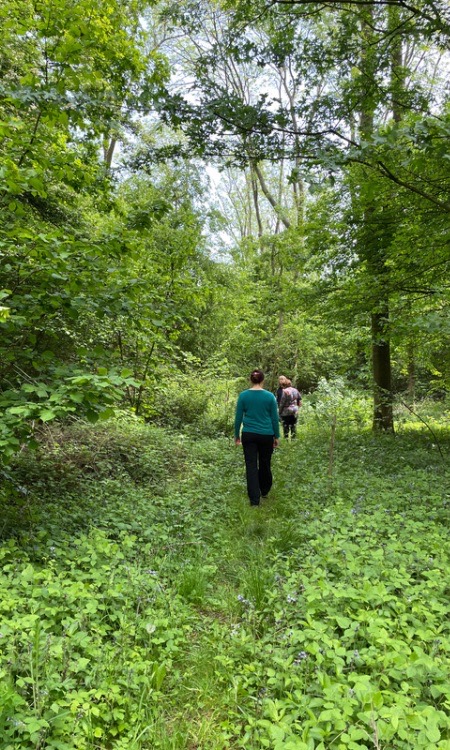
If you’re somewhere like a country park or perhaps out in the countryside somewhere, you can choose a spot to sit, or stand for about 3 – 10 minutes (work the time up). Then, bring your focused attention to noticing what’s going on around you. What you can see, what you can hear, what you can smell. Is there something tactile nearby you can touch, such as soft grasses or the bark on a tree? Tasting is another sense you can explore. You don’t actually have to pick something to taste it, you could just stick your tongue out and taste the air, or the rain if that’s what occurs whilst you’re standing or sitting.

It’s the ‘allowing’ that you have to work on with the above exercise, because your brain will have a tendency to question what you’re doing – “I’ve not got time”, or “this feels boring”. If you notice your thoughts are being unhelpful around keeping on doing this activity, you have two options – give in or stick with it. I’d recommend the latter.

Join a group to enjoy community with others

For some people, joining a nature connection type of group is the best way to start. You don’t have to join one that offers Forest Bathing or a Sound Bath in nature. In fact, one where you are guided to engage yourself in activities that feel meaningful to you and that meet on a regular (preferabley weekly) basis is what I would suggest you look for.

You might want to check out this Wednessday Wellbeing group that meets once a week. The session is billed as a way to access fresh air, friendship and fun and the way it’s run is based on the 5-ways to Wellbeing.

  • Get Active
  • Be Social
  • Learn something new
  • Care for the Environment
  • Contribute to something you feel helps nature

This group is based in an ancient woodland between Thrapston and Corby. However, if that’s not local to you then why not do a search and see what might be available in your area.

Here’s some feedback from the Wellbeing Wednesday group

“I leave my troubles at the gate”

“As soon as I get ouf of the car and start walking up the track my whirring mind quietens and I feel a sense of being able to breathe more easily”.

 If you’re suffering from anxiety or low mood as a result of a life event or personal health issue you are dealing with, please get in touch for more personalised guidance. I offer a free, no obligation, 30-minute session online to talk through potential therapeutic options to help you navigate what you are dealing with.


Enquiry for free 30 minute session

6 + 11 =

woman head and shoulders
CNHC logo

Book a free 30 minute discovery session

8 + 4 =

Hypnosis and self-improvement

Hypnosis and self-improvement

Self improvement at work

Hypnosis can be highly effective at helping you achieve your work related goals.

Hypnosis for self-improvement at work would involve guiding you to experience a state of highly focused attention, which opens up your sub-conscious mind  to accepting suggestions for positive, helpful change. Hypnosis is a gentle, natural and safe way to remove unhelpful, habitual ways of thinking that are mental barriers blocking ability/motivation to change.

Hypnosis can be harnessed to help you bring about improvement in performance at work through helping you develop greater optimism, increased motivation and generally a more positive mindset.  

Use of hypnosis for personal development at work can help with:

  • Self awareness
  • Ability to find direction and set goals
  • Increasing focus and concentration
  • Getting rid of self-limiting beliefs
  • Maximising your work potential
  • Gaining greater control over your work/life balance
  • Enhancing your work relationships
woman

Use of hypnosis to reduce work related stress

Managing stress

Stress is a fairly common factor in the workplace, resulting in burnout if not recognised and addressed. Stress reduces productivity and can be the cause of health issues such as high blood pressure, type 2 diabetes, gaining weight and engaging in addictive behaviours such as drinking and smoking. Hypnosis can provide an effective way for individuals to manage stress through altering the perception of what stresses them and reframing the stress triggers. Hypnosis can help people address underlying issues that are hindering their ability to maximise their performance at work, resulting in improved self-esteem, confidence, motivation and productivity.

Improving concentration and focus

Concentration and focus are an important aspect related to work productivity. If your mind is scattered, seemingly unable to focus on one task for long, the pressure inside of you builds and doubts begin to creep in that perhaps you are not quite up to the job. Hypnosis can improve concentration and focus, leading to improvements in how you approach the tasks in front of you, efficiently and calmly.

Getting rid of self-limiting beliefs

Self-limiting beliefs can present a major roadblock in realising your full potential at work. Hypnosis can help you replace any self-limiting beliefs, that are effectively sabotaging you, with positive, life affirming beliefs that will foster a helpful growth mindset. Shifts in mindset can effect major improvements on how you perform at work, bringing about increased motivation and greater resilience to be able to achieve work related goals.

Hypnosis can be a powerful tool for improving work performance, helping you manage stress, address any limiting beliefs that are holding you back, improving concentration and focus and generally boosting overall wellbeing. Simply put, a few session of hypnosis could be the key to help you open the door to discover and realise your full potential.

Next steps

Get in touch to find out more. Fill in the form below to book a no obligation, free 30 minute discovery session. What have you got to lose? There’s so much you could gain!

woman head and shoulders
CNHC logo

Book a free 30 minute discovery session

12 + 1 =

Originally posted 2023-09-30 14:42:06.

Develop a mindset for business and personal growth

Develop a mindset for business and personal growth

Be better at what you do

Even if you are good at what you do there is always room for improvement.  A combination of clinical hypnotherapy and IEMT (Integral Eye Movement Therapy) can help unlock your potential to boost ability to achieve greater success, through  letting go of what is holding you back and generally becoming more focused and better at what you do.

Every person, whether already feeling successful at what they do, has internal resources that have not been maximised. Being guided to access those inner resources and then utilising them to best advantage is what makes those people more successful than other people. Engaging with a few sessions of clinical hypnotherapy and/or IEMT can be instrumental in realising potential for business or personal growth.

Hypnosis can be instrumental in enhancing and improving an individual’s mental attitude and focus through embedding greater confidence in their subconscious and by helping eliminate unhelpful beliefs holding them back.

IEMT can be very effective at helping resolve underlying identity related issues that have, up to that point, stunted potential for developing that person’s full potential.

The ‘how’ of helping you

Following an initial induction interview, where your aspirations and goals are discussed in detail, a series of clinical hypnotherapy sessions would take place where you will be guided into a state of hypnosis to help you achieve the following:

  • Eliminate negative beliefs or thoughts
  • Increase dedication and motivation
  • Concentrate and relax deeply to imagine success
  • Improve self-belief and confidence
  • Overcome distraction and maintain composure
NCH logo
CNHC logo

Relaxation is key to optimising performance

When you’re under pressure it is very difficult to relax, because your mind becomes so focused on getting the job done, in the belief that once the task is completed the pressure will be relased; then you can relax. How much do you identify with that and is that what happens in practice?

Can you, I wonder, also identify with overthinking when you’re under pressure? Does your mind go into super-charge mode? You may think that’s a positive, necessary for achieving your end-goal, but actually it is more often counter-productive, with you becoming  less, rather than more able to progress towards your goal through by thinking things through clearly and creatively.

The term ‘paralysis by analysis’ has been used to describe this phenomenon of what is effectively a kind of ‘brain-freeze’ and it can impact on an individual whether they are running a business or caring for someone at home. When you’re under pressure you can feel there’s just so many jobs to be done, so much that has to be achieved to keep things running smoothly. The answer? – Just keep going until the job is done.
But I wonder, do you then take time out to recuperate by relaxing or do you just keep going until you fall into bed, your mind still whirring away that then impacts on the quality of your sleep?
If you don’t sleep properly then that then impacts further on your performance; it’s a vicious circle. 

How I can help

I can facilitate you improving your performance by helping you develop key cognitive psychhological skills; essentially about cultivating a mindset disigned to enhance performance outcomes.

Firstly I will gain an understanding of the goals you want to achieve and what unhelpful beliefs are holding you back. Secondly I will produce a plan of action that will be discussed and agreed before commencing hypnotherapy-based treatments to bring about necessary changes to be able to move steadily towards what it is you wish to achieve.

Hypnotherapy isn’t about making it happen, just through you going into hypnosis. Helpful suggestions are made to your subconscious, to help motivate and focus the mind on changing ways of thinking, feeling and behaving, but these require practice day to day to reinforce the new ways of thinking and acting. 

Hypnosis is a very natural state of mind, one where you are more open to helpful suggestions being made to improve your life experience. There is no magical transformation but hypnosis can be transformative in how it helps individuals achieve the goals they seek. 

If you would like to find out more about how hypnosis could help you cultivate a mindset for growth, for business or in your personal life, then please get in touch for a free 30 minute discovery session. You can phone/message me on 07483 234109 or send a message using the form below.


woman head and shoulders

Book a free 30 minute discovery session

5 + 15 =

Originally posted 2023-08-22 15:51:02.

What you eat can stop you losing weight

What you eat can stop you losing weight

Why eating well, not eating less is key to weight loss 

How much control can you have over your weight?

To be able to let your excess weight go, permanently, is going to need more than reducing your calorie intake. Sure, eating less can deliver the desired result of the pounds falling away, but all too often your body seems to fight back and you regain what you’ve lost and often more. Is that your experience? 

I’m not here to offer you a quick-fix solution, rather to put some information before you help and encourage you to understand the broader picture of what changes you need to make in your life to effectively let that weight you don’t want, go! 

Firstly, consider your genes (not the blue ones). Look at your mother, your aunt, wider family members and consider their shape and size and ask yourself what is a realistic goal to have that will be sustainable for you in the long terms. Carrying too much weight is not good for many health-related reasons, but learning to feel better about being perhaps just a little lighter, rather than a lot, might be more realistic.

However, whatever your genetic predisposition to be a certain size, your lifestyle is going to be a very important factor in being able to manage your weight long-term. There are two areas I’m going to talk about in this blog post, one to do with gut-health and the second to do with the actual food we eat.

NCH logo
CNHC logo

Gut health

Did you know your gut (where your food digestion takes place) plays an important role in your overall health?

Within your gut you have many different types of bacteria that work on breaking down the food you eat, extracting nutrients that are then ‘fed’ into your body. However, a growing number of scientific studies have linked obesity with a lack of diversity in lower gut bacteria, due to the actual type of foodstuffs being consumed. The result of this lack of diversity in gut bacteria means there is a distinct possibility of a range of health related issues being experienced by that person including, you may be surprised to learn, struggling to keep their weight down. You don’t have to take my word for it, you can read more about how gut bacteria can influence weight, here. 

What do you know about what you eat?

Many of us take what we eat for granted, having a “if it’s in-date it’s okay” way of approaching food we buy. Advertising and/or food packaging tempts us, not to mention the buy one get one half-price offers.

Before you enter into any weight loss programme, whether one you pay for or one of your own design, I’d strongly advise you spend some time finding out about processed foods. There’s so much food we are led to believe is healthy for us that actually isn’t. 

My husband ate a particular breakfast biscuit cereal daily, for several years, on the basis that it was pure grain-based. The marketing about the cereal product promoted the benefits of it being a healthy food choice to start the day. Imagine his surprise when, watching a programme about processed foods, he discovered that in fact that food came into the ultra-processed category and was not at all a healthy option to be eaten on a daily basis. So, the moral of this story is – understanding exactly what you are eating is not just important but empowering in being able to make conscious, healthy choices.

Processed foods include canned fish, fruits in syrup, bottled vegetables, cheese, fresh bread.

Ultra-processed foods include soft drinks, many breakfast cereals, sweet or savory packaged snacks, premade frozen meals.

You can find out more about processed and ultra-processed foods here

It’s said that eating food that is closest to its natural state is the way to go, but that can be very challenging. Recently I was out and about and felt very hungry and so went in search of a healthy snack. I walked up and down the aisles in my local supermarket and it really brought to my attention just how difficult it is to buy a healthy snack. The shelves were full of tempting sausage rolls, pre-made sandwiches, pork pie, scotch egg (I’m getting hunger pangs just typing this) but little in the way of healthy options. In the end I bought a banana, which did the trick to take me through to my next meal-time. 

Buying healthy options can be expensive, salmon for example. However, with some reading around the subject you will find out more about what is healthy to eat and what is definitely not. Aiming to cut out all unhealthy options is a bit unrealistic, but understanding more about what’s classed as a natural food, a processed food and an ultra-processed food will help you make better food buying and eating choices.

You might want to check out my hypnosis-based letting weight go course, using clinical hypnosis, that runs over 4-weeks. If you think the programme might be helpful to you then get in touch and we can have a chat. I don’t accept everyone onto the course, only those who demonstrate they are really committed to changing, because in my opinion it takes changing your whole relationship with food to experience long-lasting success with keeping your weight within a range you feel is right and healthy for you. Find out more about how you could let unwanted weight go. Phone/message me on 07483 234109 or fill in the form below to book a free 30-minute ‘discovery’ session.

woman head and shoulders

Book a free 30 minute discovery session

5 + 7 =

Originally posted 2023-08-17 14:25:56.

Hypnosis and self-hypnosis overview

Hypnosis and self-hypnosis overview

Hynosis and self-hypnosis

How hypnosis could help you

Hypnosis (whether hypnotherapy or self-hypnosis) provides the way to access your subconscious mind, with the aim of making positive changes to the way you think.

Becoming more aware of your habitual ways of thinking, rather than being locked into automatic thinking shaped by past experiences, is the first step to changing your experience of how you live your life.

Hypnosis can be an energising force, helping you focus your attention on replacing unhelpful with more helpful ways of thinking. Quite simply, hypnosis can bring about ‘helpful’ changes in the way you think, feel and behave, in relation to yourself and others. 

Hypnotherapy and self-hypnosis can also help promote new ways of thinking about whatever is at the root of your current suffering, whether the cause is rooted in emotional or physical pain. Hypnosis holds the key to developing a  new  mindset about whatever is currently causing issue for you. 

How hypnosis works

Being in a hypnotic trance effects a bypass of the conscious mind, allowing helpful suggestions to be introduced into the subconscious mind. ‘Suggestions’, made by person themselves in self-hypnosis or by the therapist in hypnotherapy, are more likely to be accepted and integrated into the subconscious mind, helping the person in hypnosis to adopt, rather than reject, new ways of thinking.

The conscious mind is often resistant to change, due to fear, anxiety, or other factors. Hypnosis helps to bypass any resistance by the conscious mind by working directly with the subconscious mind. It is in the sub-conscious mind where our beliefs are rooted and where those beliefs can be reshaped to bring about positive change in how a person thinks, feels and behaves.

Self-hypnsosis

Self-hypnosis can be a very useful skill to learn and the hypnosis state it provides can be accessed easily anywhere and at any time of day or night. Self-hypnosis can become a person’s portable and very user-friendly personal support mechanism.

For those motivated to try using it, self-hypnosis is quite safe, facilitating the unconscious mind to accept positive, helpful suggestions, naturally rejecting any that may not suit. Additionally, in situations where a person is feeling at a loss of control in their circumstances, which can be both comforting and empowering.

NCH logo
CNHC logo

How hypnosis works

On a very basic level, hypnosis (whether hypnotherapy treatments or self-hypnosis) induces relaxation and when a person is in a calm state they are more receptive to being open to new ideas. In a state of hypnosis a person becomes more open to suggestions about new ways of thinking that can be very helpful in improving their life experience.

There are some situations where hypnosis should not be used, for example where someone is suffering from uncontrolled epilepsy, psychosis or has a brain tumour or TBI (Traumatic Brain Injury). Speaking with a qualified hypnotherapist will provide you with guidance as to what therapeutic approach will be most suitable to help support whatever needs you identify. 

How I can help

I provide a free 30 minute discovery session for the purpose of providing information and guidance on what therapeutic approach might be most suitable to meet your needs. Please be aware I work with people to help them maximise the success potential of prescribed medication/medical interventions, not as an alternative to engaging with them. 

You can make contact with me by filling in the form below, or by making a phone call or sending a text to 07483 234109

Book a free 30 minute discovery session

7 + 5 =

Originally posted 2023-08-14 10:26:09.